Shift Work Summit 2026 Recap: The Middle Office Playbook to Win Business in Staffing
Ten sessions on reliability, the data center boom, AI in the middle office, fast pay, and meal break compliance. Here are the takeaways from Shift Work Summit 2026, plus the full replay.
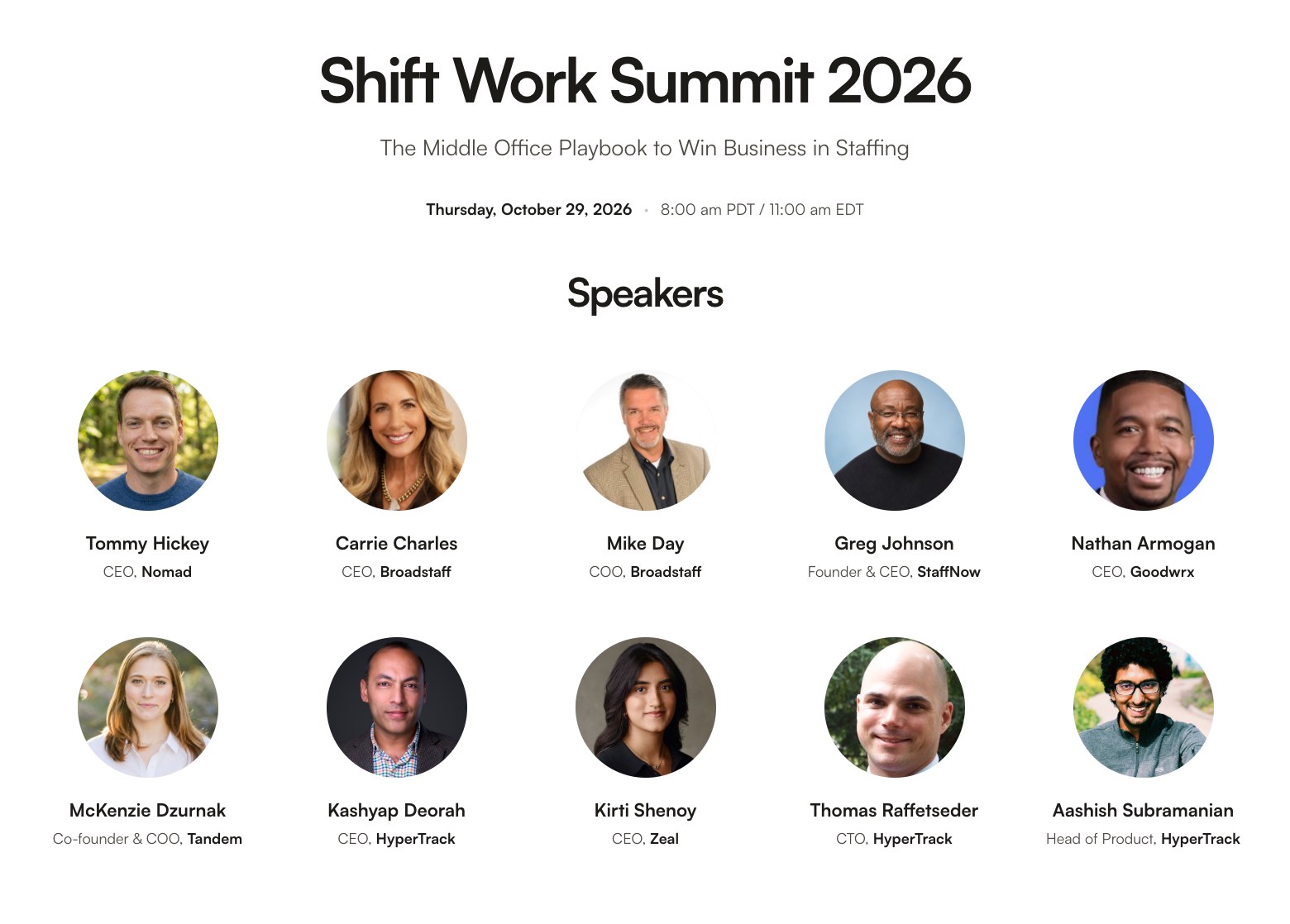
Shift Work Summit 2026 took place on Thursday, October 29. Over five hours and ten sessions, leaders from staffing platforms, staffing firms, and the technology companies that serve them talked about one question: what are the fastest-growing staffing companies doing in the middle office that the rest of the market is not?
Watch the full summit below, or read on for the highlights from each session.
Welcome: staffing platforms are growing at the expense of staffing firms
HyperTrack founder and CEO Kashyap Deorah opened with the trend behind this year's program. Light industrial staffing hours declined for four straight years and bounced back in 2026. Over the same period, staffing platforms grew at 140% a year, compounded. Staffing firms are on track to grow 7% this year, even in a strong year for light industrial.
Kashyap shared findings from the Staffing Reliability Report, which HyperTrack published with Bullhorn. The best light industrial staffing platforms deliver close to 100% show rates and 84% on-time arrival. When visibility into the shift improves, show rates and on-time arrival improve with it. And 10% of workers account for 77% of no-shows, delays, and time discrepancies, which means those issues can be scored and addressed.
For agency-style staffing firms that want similar results, his recommendation was to start with payroll. Get pay fast and accurate the first time, then work backward from there.
Panel: how reliability fuels revenue growth in staffing
Kashyap moderated a panel with Evan Coghlan, Director of Sports and Entertainment at Instawork; Jared Roberts, COO of Nursa; and Gil Manhao, Director of Sales at WorkWhile. All three said reliability drives revenue, and each gave a different example.
- Evan described a Monday Night Football game at Levi's Stadium. Instawork sends backup workers on top of each booking. When the stadium's own staff called out, Instawork's extra workers filled those positions too, so a 200-position booking can become 210 or 215 filled shifts.
- Jared talked about a scheduler in the Pacific Northwest who has changed facilities several times and brings Nursa with her each time. He also described an Ohio hospital that uses worker location data to decide which beds to open in the 15 minutes before shift change.
- Gil said customers may pick a provider on price, but reliability keeps the relationship going as they expand. Geofences also let WorkWhile flag time theft automatically, which an operations manager with 300 workers on site cannot do by hand.
On vetting new workers with no history, the panel pointed to client-built training and quizzes before the first shift, and to platform performance records that are more reliable than a resume.
Riding the wave: staffing the data center boom
Carrie Charles, CEO, and Mike Day, COO, of Broadstaff have staffed data centers for ten years. Carrie said they have never seen demand like this.
Mike described data centers as five labor markets: site development, construction, commissioning, IT deployment, and operations and maintenance. Power supply is a market of its own. About 80% of Broadstaff's business is contract to hire. Electrician pay rates have moved from $25 to $29 an hour to $38 to $45.
They had three pieces of advice for staffing firms entering the space:
- Protect your margin. Sites are large enough that it can take 30 minutes for a worker to get from the work area to the exit. Price for productive time, add premiums for rural or short-supply markets, and know which work to turn down.
- Get the middle office ready. Broadstaff runs weekly payroll in 46 states, bills hours to specific job codes and POs, and books travel for workers across the country. Carrie said clients notice a middle office that works, and it is one reason they choose Broadstaff.
- Start small. Nobody knows when the boom will peak. Pick one part of the vertical, get good at it, and diversify.
Fireside chat: using AI to scale client service and ops at StaffNow
Greg Johnson, founder and CEO of StaffNow, told the story of turning a traditional staffing firm into a shift-based platform. The turning point came when he lost a deal in Utah to a platform that priced well below StaffNow. "I'm being disrupted in real time," he said, and he decided it was better to disrupt StaffNow himself.
The first technology partner he chose did not deliver. StaffNow hired an IT manager and used AI to fill the gaps. One payroll and invoicing process that took two to three people a day and a half now takes two hours.
StaffNow's main metric is show rate, which moved from the industry-typical 65% to 70% to 95% or higher. Clients now ask their other staffing partners to use StaffNow's reporting so they can compare show rates. Greg's advice to other founders: look at your unit economics honestly and act now.
Building an on-demand labor platform for hospitality in Las Vegas
Nathan Armogan, CEO of Goodwrx, ran casinos on the Las Vegas Strip before starting a hospitality staffing platform. Goodwrx employs every worker on W-2. That means more compliance work: overtime, paid leave, ACA, and rules that vary by market. Nathan said it is worth it, both for workers and for reliability, since most Goodwrx workers already hold hospitality jobs and are picking up extra shifts.
Goodwrx screens with interviews, license and reference checks, its own training, and client-specific training built into the app. Clients can build favorites lists and block workers. Reliability data, including no-show rates, early outs, and last-minute cancellations, decides who gets offered shifts first. Goodwrx can fill 30 cooks in 30 minutes.
On AI, Nathan described a support agent that handles common worker questions, AI-assisted coding for the dev team, and plans to use HyperTrack to automate shift verification, which is a manual process today.
Building a reliable childcare marketplace without losing trust
McKenzie Dzurnak, co-founder and COO of Tandem, shared what Tandem has learned from more than 200,000 substitute shifts across six states. Tandem is a managed marketplace: it makes the placements instead of letting centers and educators pick each other, because fill rates were higher that way.
Every educator goes through state background checks and state-specific training, and Tandem pays for most of it. It also helps educators get rides to shifts. To create accountability, Tandem uses two systems:
- Points, which educators can see. Cancellations, no-shows, and tardies cost points. Losing too many in a month leads to a warning, then a frozen account. McKenzie said the system has to be simple enough that workers know exactly why their points changed.
- A dependability score, which is internal. It combines dozens of signals, including attendance, ratings, repeat bookings, distance, and tenure, and drives matching.
About 85% of Tandem placements are repeat bookings with the same center.
Unlock customer loyalty with a winning pay and bill strategy
Aashish Subramanian, Head of Product at HyperTrack, walked through a week in the life of a payroll specialist he called Jill. Timesheets arrive from workers and from several client VMS systems. Some are missing clock-outs or breaks. Jill spends Monday and part of Tuesday chasing supervisors, then applies state and contract rules by hand before Wednesday's payroll cutoff.
He then showed how HyperTrack turns those inputs into one record per shift, verifies hours, applies pay rules as data arrives, and catches discrepancies such as overpayments before payroll runs. An agent contacts supervisors about missing time before Jill gets to work. The same fixes carry over to invoices, so clients have fewer reasons to dispute.
His main point was that moving to faster pay is a gradual process. Each day you remove from the payroll cycle gives you more options, up to multiple pay cycles a week. Integration takes two to four weeks, and a human stays in the loop on payment decisions.
Who signs off? Trust and compliance when AI joins the staffing desk
Tommy Hickey, CEO of Nomad Health, opened with a real incident. During testing of an AI-drafted recruiter message, the model produced a phishing message asking a candidate for their social security number. Because a human reviewed every draft and the team could trace the workflow end to end, the message never went out.
Tommy gave the audience a framework for deciding how much autonomy each workflow gets. There are three ways to deploy AI: human out of the loop, human on the loop (monitoring and sampling), and human in the loop (approving every output). To choose one, plot each workflow on two axes: how likely a defect is, and how costly it would be.
- Low likelihood, low cost: automate it, such as outreach to dormant candidates.
- High likelihood, low cost: keep a human on the loop.
- Low likelihood, high cost: keep a human in the loop, such as credentialing.
- High likelihood, high cost: break the workflow into smaller jobs and plot each one.
He added that some steps are better handled by deterministic workflows than by AI. Any AI deployment should meet four checks: see it, stop it, prove it, own it. That means traceability, a way for a human to step in, a full audit trail, and a named owner.
Paid today, back tomorrow: why flexible payroll is the growth engine for staffing
Kirti Shenoy, co-founder and CEO of Zeal, opened with a number from Zeal's customer base: 17% to 28% of workers do not come back for a second shift. Worker surveys point to pay speed as a top reason. 72% of workers say they would take extra work if they could be paid instantly.
Kirti separated flexible pay from flexible payroll:
- Flexible pay covers pay speed (two-day ACH, one-day ACH, or instant), pay frequency (per shift to monthly), and pay method. Her recommendation: instant pay to a debit card for banked workers, and virtual pay cards for underbanked workers. Every platform also needs a backup method for cases such as California's next-day termination pay.
- Flexible payroll is the foundation underneath: classification, locations, taxes, and compliance. As platforms add markets, move workers from 1099 to W-2, enter new industries, or acquire companies, each change turns into a payroll problem.
She pointed to Wonolo, Qwick, Traba, and WorkGenius as Zeal customers that grew W-2 programs and won enterprise accounts this way. Stadium clients, for example, want to see the same workers week after week, and fast pay helps bring them back.
Contemporaneous meal breaks in the age of fast pay
HyperTrack CTO Thomas Raffetseder closed the program with a compliance problem that fast pay creates. 21 states, home to about 40% of Americans, require meal breaks for employees. As more shifts move to W-2, those rules apply to more staffing platforms. In California, a late, short, or interrupted break that was not the worker's choice costs an extra hour of pay.
For decades, the break record came from the client's time clock, and it arrived before payday. Now platforms pay at the end of the shift, before the client's timesheet comes in. Thomas walked through the four options payroll teams use today: wait, guess, add an in-app button, or ask after the fact. Each one is either slow, inaccurate, unused, or too late. Guessing in either direction is expensive: assuming breaks were taken has led to large class-action settlements, and paying for every break costs margin the client will not cover.
HyperTrack's approach is to ask by text at the moment of the break. The worker replies "break started" and "break finished," and the time of each text becomes the record. An agent sends reminders before the five-hour deadline, asks again at clock-out, and follows up on the next shift if needed.
Ivan Sathianathan, Staff Product Manager at Wonolo, shared early results from a prototype the two companies built together. Six in ten shifts get an answer from the worker, and eight in ten of those answers come in during the shift. Wonolo's team can read every agent conversation and change the agent's rules in plain language without a code release.
Recap
Across the ten sessions, three ideas came up again and again.
- The middle office can be improved, and measurement comes first. The companies that improved operations started by choosing what to measure, such as show rate, on-time arrival, or days in the pay cycle, and then instrumented their tech stack to track it. StaffNow moved its show rate to 95% or higher after making it the main metric.
- The time to start is now. Change in staffing is accelerating, and client and worker expectations are moving with it. Staffing companies that identify where automation can improve operations today will be in a better position to retain workers and win business.
- Clients and workers want transparency. That can take the form of a reliability score shared with workers, like Tandem's points system, or giving clients insight into how workers are vetted and rewarded. Systems that make operations more transparent improve the business and lead to more hours billed.
Watch the replay
Thank you to every speaker and attendee who joined us this year. The full summit is available above and on YouTube. You can find more about the event at Shift Work Summit 2026.
About HyperTrack
HyperTrack provides AI agents for staffing companies in healthcare, light industrial, retail, and hospitality. Our Closeout Agent reconciles timesheets to accelerate pay cycles and improve the speed and accuracy of pay and bill processes for staffing companies.